Phase 0
Environment variables and configuration, done right
Where secrets and settings actually belong, and why hardcoding them into your code is a problem waiting to happen.
The problem hardcoding creates
const dbPassword = "prod-password-123";This works. It also means the password is now sitting in your source code, in your git history forever even if you delete the line later, visible to anyone with repo access, and identical whether the code is running on your laptop or in production. Change the password and you have to edit code and redeploy just to rotate a credential - which means, in practice, nobody rotates it.
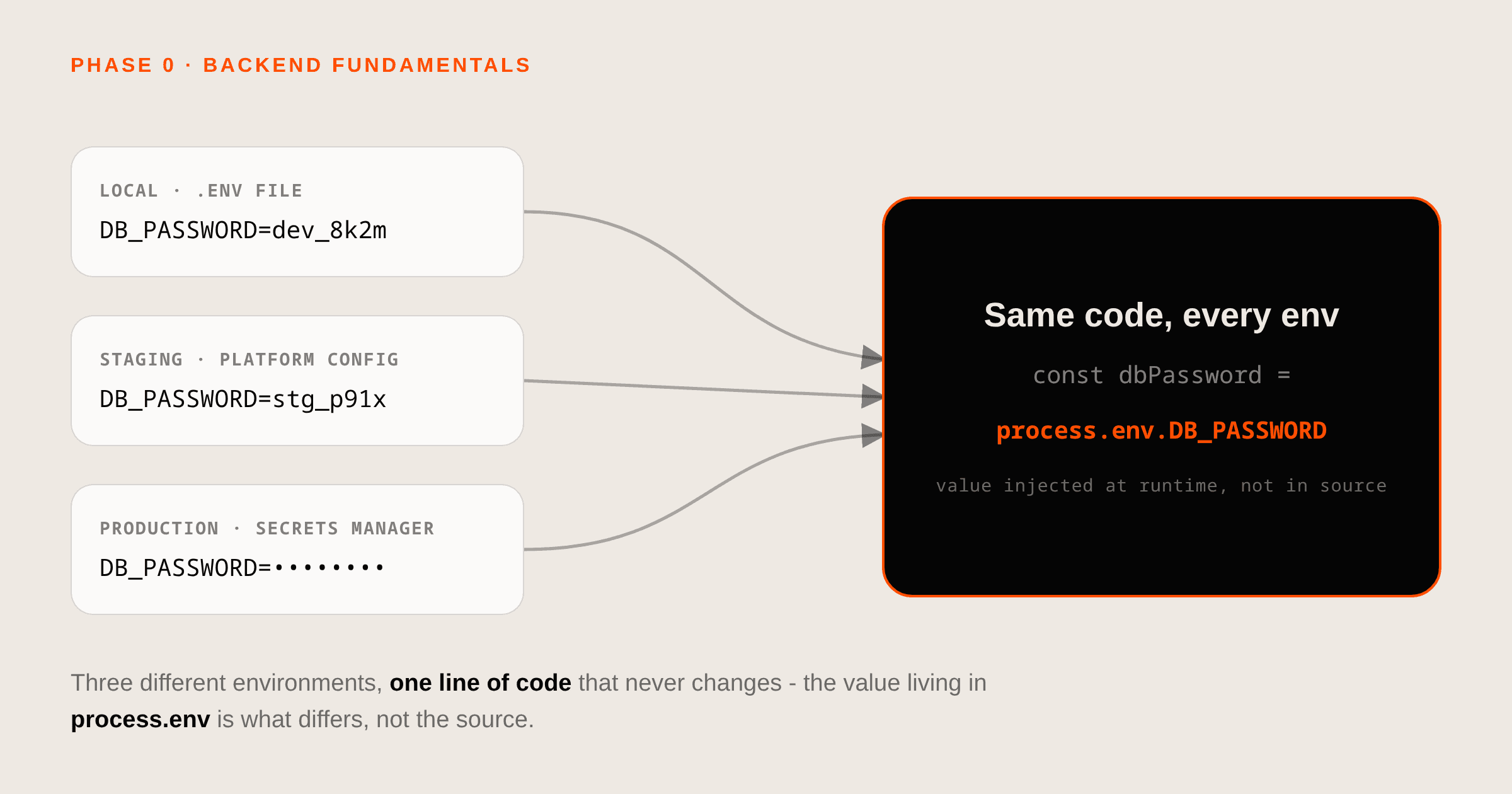
Environment variables exist to pull exactly this kind of value out of the code entirely. The code says "read whatever's in DB_PASSWORD" - the actual value lives outside the code, injected by whatever's running it.
const dbPassword = process.env.DB_PASSWORD;Same code, but now the actual secret can be different in every environment, never touches version control, and can be rotated without a single code change.
What an environment variable actually is
It's a key-value pair that the operating system (or whatever's launching your process - a shell, a container runtime, a hosting platform) makes available to a running program. Nothing fancier than that. Set one before starting a process, and that process can read it:
DB_PASSWORD=secret123 node server.jsIn local development, a .env file is the common convention - a plain text file of KEY=value lines that a library like dotenv loads into process.env at startup, so you don't have to type them out by hand every time.
Config, not just secrets
Environment variables aren't only for secrets - they're for anything that legitimately differs between where the code is running: a database URL that points somewhere different in staging versus production, a feature flagFeature flagA toggle that turns a piece of functionality on or off without a new deploy, used to roll out changes gradually, run experiments, or kill a broken feature instantly. that's on in one environment and off in another, the port the server listens on.
The underlying principle (formalized as one of the points in the well-known "twelve-factor app" methodology) is: the code should be identical everywhere it runs. What changes between environments should live entirely in configuration, never in a branch of code that checks "if we're in production, do X."
Reaching for process.env.SOMETHING at the point of use means a typo or a
missing variable surfaces whenever that line first executes - which might be a
request handler nobody hits until Friday night. Reading everything once at
startup moves that failure to boot time, where a deploy fails loudly instead:
Loading config once, and failing fast
jsWhere this file sits in the startup order
The object on line 11 is built the moment this module is first imported, so everything below runs before the server binds a port. That timing is the whole point - it is what turns a config mistake into a failed startup instead of a failed request.
The rest of the codebase imports config and never touches process.env again.
That also makes the full set of variables the app needs readable in one file,
which is the list you want when setting up a new environment.
What still shouldn't go in an environment variable
Not everything belongs here. Environment variables are plain text, readable by anything with access to the process, and not encrypted at rest by default in most setups. For genuinely sensitive secrets at any real scale - production database credentials, signing keys - dedicated secrets managers (AWS Secrets Manager, HashiCorp Vault, or a cloud provider's equivalent) exist specifically because "just an env var" doesn't give you rotation, access auditing, or fine-grained permissions.
For a side project or a small team, environment variables plus a .env file kept out of git is a completely reasonable stopping point. The distinction to hold onto is: environment variables move secrets out of code. A secrets manager moves them out of plain text too. Different problems, and you don't need the second one until the first one stops being enough.